
An unexpected customs bill can turn a profitable import into an expensive business decision.
For UK businesses buying products, raw materials, machinery, or packaging from overseas suppliers, customs charges are an important part of calculating the real cost of importing goods. The supplier’s invoice may show the purchase price, but additional expenses can arise when goods enter the country.
These expenses may include Customs Duty, import VAT, customs clearance charges, handling fees, and other costs related to transporting the shipment.
Understanding UK customs charges before placing an order helps businesses prepare realistic budgets, protect their profit margins, and avoid unpleasant surprises when goods arrive.
This guide explains how import duty and VAT work, what customs clearance costs may include, and how businesses can estimate their total import expenses.
What Are UK Customs Charges?
UK customs charges are taxes, duties, and service fees that may arise when goods are imported into the country. The amount payable depends on factors such as the type of product, its customs value, country of origin, applicable trade arrangements, and the services required to clear and deliver it.
The main costs businesses should understand are:
- Import duty: A government charge that may apply to imported goods, depending on their classification and applicable tariff rules.
- Import VAT: VAT charged on eligible imports, calculated using the relevant import VAT value.
- Customs clearance charges: Fees charged by a customs agent, freight forwarder, or other service provider for handling the clearance process.
- Additional shipping costs: Depending on the shipment, these may include handling, storage, transport, insurance, or other applicable fees.
These charges are not all the same. The amount paid to HMRC for duty or VAT is separate from the money a business pays a customs agent to handle its paperwork. Some shipments may also qualify for reliefs or special arrangements.
Why UK Customs Charges Matter for Businesses
Customs expenses directly affect how much a business pays to bring products into the UK. If these costs are not included in the original budget, the final landed cost can be much higher than expected.
1. Protecting Profit Margins
Imagine a retailer importing products at a competitive purchase price. If the business overlooks import VAT, applicable duty, and clearance fees, its actual cost per item may increase significantly.
This matters when setting wholesale prices, retail prices, or promotional discounts. Understanding the full cost helps businesses decide whether an overseas supplier offers genuine value.
2. Planning Cash Flow
Some import expenses must be paid before goods can be released or delivered. Businesses need to understand when payments are due and whether any available VAT accounting or customs arrangements suit their circumstances.
Accurate planning can reduce the risk of having goods ready to move but insufficient funds available to cover outstanding charges.
3. Avoiding Clearance Delays
Incorrect product classifications, missing documents, or inconsistent shipment information can lead to customs queries and additional work.
Preparing accurate paperwork before dispatch helps reduce avoidable problems. It is particularly important for businesses importing regularly or handling goods subject to additional controls.
4. Making Better Supplier Decisions
A supplier offering a lower product price may not produce the lowest overall cost once transport, taxes, and clearance are considered.
Comparing the complete import cost gives businesses a more reliable basis for choosing suppliers and negotiating purchasing terms.
What Is Import Duty in the UK?
Import duty, commonly referred to as Customs Duty, is a charge that may apply when goods enter the UK customs system.
To work out the duty on a shipment, businesses need to identify the product correctly, establish where it originates, determine its customs value, and check whether any special tariff arrangements apply.
How Is Import Duty Calculated?
For many goods, the duty calculation uses the customs value multiplied by the applicable duty rate. However, some products may be subject to specific duties or other calculation methods.
A simplified example:
| Calculation | Illustrative Amount |
|---|---|
| Customs value | £10,000 |
| Assumed duty rate | 5% |
| Import duty | £500 |
This example assumes a 5% rate purely to demonstrate the calculation.This percentage is used only to explain the calculation and should not be used when budgeting for a real shipment.
To identify the correct rate, businesses should use the official UK Trade Tariff and check the commodity code, origin, and applicable measures.
Why the Commodity Code Matters
A commodity code identifies the goods being imported. The classification helps determine the applicable duty rate and whether licences, certificates, or additional requirements may apply.
For example, different types of machinery, clothing, food products, and packaging materials may fall under different tariff classifications.
Choosing a code based only on a general product description can lead to an incorrect calculation. Businesses should check the product specifications and seek professional classification support where necessary.
Can a Business Reduce Import Duty?
In some circumstances, a business may pay a lower rate or qualify for relief. A business can benefit from a special customs arrangement only when its goods and circumstances satisfy the relevant eligibility criteria.
Possible considerations include:
- Reduced duty rates available through qualifying international trade deals.
- The origin of the goods and the evidence required to support a preference.
- Eligibility for a customs relief or special procedure.
- Correct classification of the imported product.
A product being shipped from a particular country does not automatically mean it qualifies as originating there for preferential tariff purposes. Check the relevant origin rules before including any expected savings in your budget.
Understanding Import VAT in the UK
Import VAT is VAT that may be due when goods enter the UK. For many goods, the applicable rate follows the rate that would generally apply to the same goods supplied within the UK. Depending on the type of goods and their circumstances, a business might qualify for a lower VAT rate, a zero rate, or a specific import scheme.
The VAT rate should therefore be checked for the particular goods rather than assumed to be identical for every import.
How Is Import VAT Calculated?
Import VAT is not necessarily calculated on the purchase invoice alone.
HMRC’s valuation guidance explains that the import VAT value generally includes the customs value, applicable Customs Duty and other relevant import charges, along with qualifying incidental expenses such as certain transport and insurance costs.
A simplified example, assuming standard-rate VAT of 20% applies:
| Calculation | Illustrative Amount |
|---|---|
| Customs value | £10,000 |
| Import duty | £500 |
| Other costs included in the VAT value | £300 |
| Import VAT value | £10,800 |
| Import VAT at an assumed 20% | £2,160 |
The £300 is illustrative, and the example assumes all the stated amounts are included in the VAT value under the applicable rules. Actual calculations may differ.
Can VAT-Registered Businesses Reclaim Import VAT?
A VAT-registered business may be able to recover eligible import VAT, subject to the normal rules on business use, evidence, and recoverability.
Eligible businesses may also be able to use postponed VAT accounting, which allows import VAT to be accounted for through the VAT Return rather than paid immediately at the point of import, subject to the applicable requirements.
Import VAT should not automatically be treated as a permanent business expense. Its cash-flow impact and ultimate cost depend on the business’s VAT position and whether recovery is permitted.
Businesses that are not VAT-registered generally cannot reclaim import VAT through a VAT Return.
For details, refer to HMRC’s official guidance on VAT on imports.
What Are Customs Clearance Charges in the UK?
Customs clearance charges UK businesses encounter are fees for services involved in preparing or processing customs declarations and supporting the movement of goods through the relevant procedures.
These fees are separate from government duties and taxes. Their amount depends on the provider, type of shipment, declaration requirements, and any additional work involved.
A freight forwarder or customs agent may charge for services such as:
- Preparing and submitting customs declarations.
- Checking shipment documents.
- Coordinating with carriers or other parties.
- Handling amendments or additional declarations.
- Managing certain customs-related administration.
Not every provider includes the same services in its quotation. Some charge a fixed fee for a straightforward declaration, while more complicated shipments may involve additional charges.
Before confirming a booking, ask for an itemised quotation and check whether the fee covers the full clearance process or only specific tasks.
Other Import Costs UK Businesses Should Budget For!
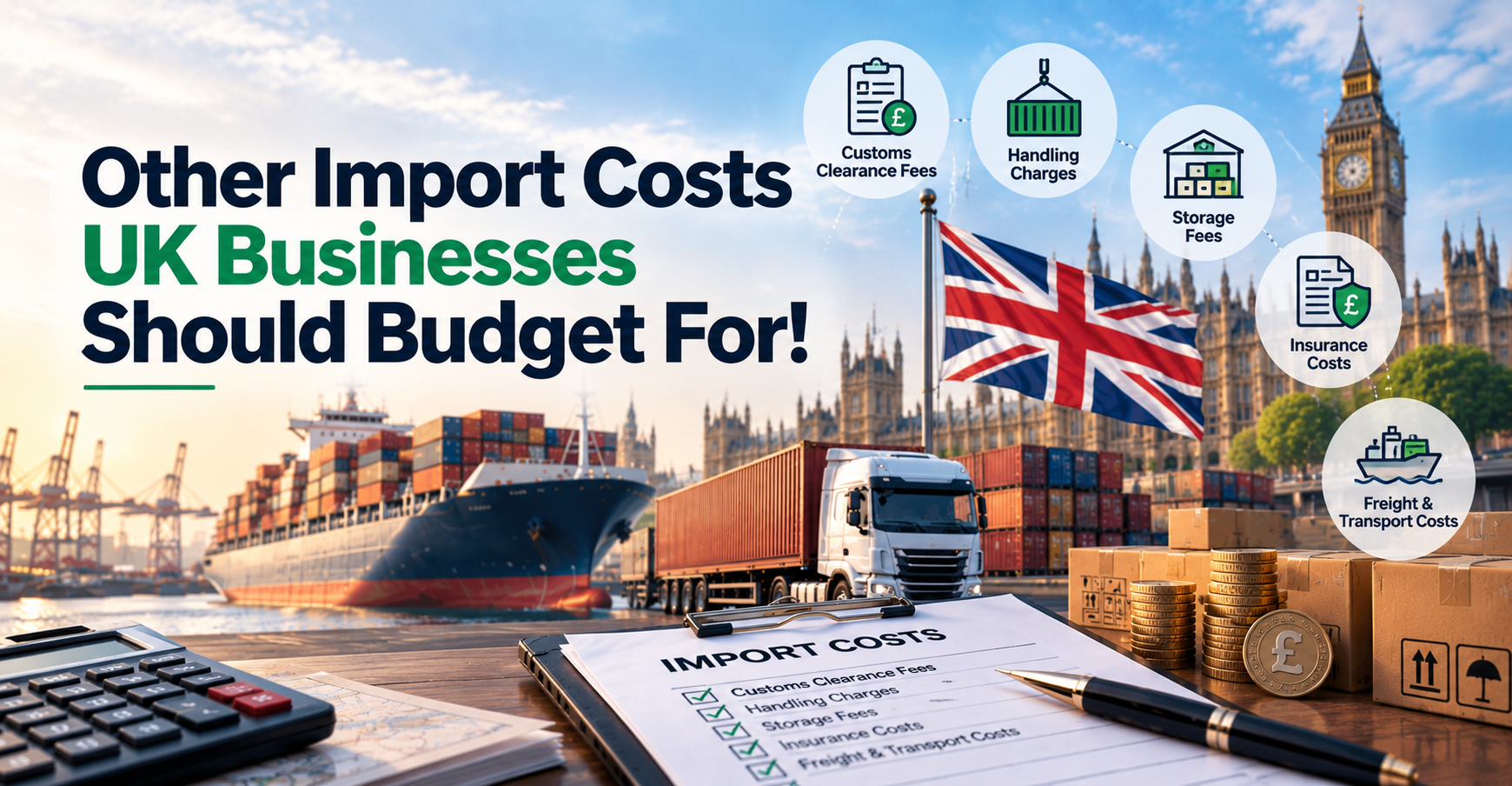
Import costs UK businesses face can extend beyond duty, VAT, and declaration fees. Depending on the transport arrangement, additional expenses may include the following.
Freight and Delivery
Air, sea, road, and rail freight have different pricing structures. The shipment’s dimensions, weight, route, urgency, and handling needs can all affect the final amount.
Port and Handling Fees
Some shipments incur terminal handling, unloading, or other operational charges. Confirm which costs are included in the freight quotation.
Storage and Delay-Related Charges
If documents are missing or a shipment cannot be collected on time, storage or other delay-related fees may arise. The applicable charges depend on the circumstances and provider terms.
Insurance
Businesses may choose cargo insurance to protect against specified losses or damage. Check the policy terms, exclusions, and limits rather than assuming that the carrier’s or forwarder’s liability covers the full value of the goods.
Product-Specific Requirements
Some goods require permits, inspections, certificates, or specialist handling. These requirements may add costs and should be investigated before the goods are dispatched.
How to Estimate Your Total Import Costs
A practical way to prepare an import budget is to calculate each cost category separately before combining them.
Step 1: Establish the customs value. Gather the relevant transaction information and determine which costs must be included under the customs valuation rules.
Step 2: Confirm the commodity code. Use the UK Trade Tariff to identify the relevant classification and check the applicable duty rate and measures.
Step 3: Check the country of origin. Determine whether any preferential tariff treatment or other special rule may apply, and confirm the necessary evidence.
Step 4: Estimate import duty. Apply the relevant duty method and rate to the correct customs value.
Step 5: Work out import VAT. Establish the VAT value using the relevant rules, including any applicable duty and qualifying additional expenses.
Step 6: Add service and transport charges. Include clearance fees, freight, handling, insurance, storage, and delivery where applicable.
Step 7: Review VAT recovery and payment timing. Establish whether import VAT may be recoverable and whether an arrangement such as postponed VAT accounting is appropriate.
The result is a more useful estimate of the shipment’s landed cost. Keep tax liabilities, recoverable VAT, and commercial service fees separate in your records, because they may affect cash flow and profitability differently.
Choosing the right logistics partner can also help businesses plan shipments and understand the services involved in the import process. Read our guide, How to Choose the Right Freight Forwarder in the UK: A Complete Guide for Businesses, to learn what to consider when selecting a freight forwarder.
Common Mistakes to Avoid When Calculating Customs Charges
Using an Incorrect Commodity Code
An incorrect classification can lead to the wrong duty calculation and may cause declaration problems. Verify the code against the product’s actual characteristics.
Calculating VAT Only on the Invoice Price
The import VAT value can include duty and other relevant costs. Using the purchase invoice alone may therefore produce an inaccurate estimate.
Assuming Every Product Has the Same Duty Rate
Tariff treatment varies by product and can depend on origin and applicable measures. Check the specific goods instead of relying on a general percentage.
Overlooking Customs Agent Fees
A quotation covering transport may not include every declaration or clearance charge. Confirm the service scope before booking.
Ignoring Payment Timing
Even if a business expects to recover eligible import VAT, it still needs to understand the applicable accounting arrangements and payment obligations.
Best Practices for Managing UK Customs Charges
Businesses can make importing more predictable by following a few practical steps.
- Collect accurate supplier information: Make sure invoices, product descriptions, quantities, and values are consistent.
- Check requirements before shipping: Confirm the commodity code, origin, duty treatment, and relevant documentation early.
- Compare complete quotations: Ask providers to separate freight, clearance fees, and other service charges.
- Keep customs records organised: Store invoices, declarations, tariff information, and evidence supporting any preferential treatment or relief.
- Review landed costs regularly: Recalculate costs when product prices, routes, exchange rates, or applicable tariff measures change.
- Ask for help when needed: A qualified customs agent or freight forwarder can assist with documentation and shipment coordination, although the business should understand its own obligations.
How NN Freights Ltd Can Fit Into Your Import Planning
Understanding customs charges is one part of organising an international shipment. Businesses also need to coordinate transport, documentation, clearance arrangements, and delivery schedules.
When planning an import, you can contact NN Freights Ltd to discuss your freight requirements and clarify which logistics services may be relevant to your shipment.
Before booking, provide accurate details about the goods, origin, destination, shipment size, and expected timing. Ask for a clear breakdown of the services offered and any charges that may apply.
This makes it easier to assess the full logistics budget alongside the estimated duty and VAT, rather than treating customs as an unexpected expense after the goods arrive.
Future Outlook: Why Import Cost Planning Will Remain Important
International supply chains can be affected by changes in trade arrangements, transport prices, border procedures, and customs requirements.
For UK businesses, the practical response is to keep import calculations up to date and avoid relying on old estimates for recurring shipments. A tariff rate or clearance arrangement that applied to one consignment may not necessarily apply to another product or country of origin.
Digital records, consistent supplier documentation, and regular reviews of landed costs can make import planning more reliable. Businesses that understand both their tax obligations and their logistics expenses are better positioned to price products accurately and manage cash flow.
Conclusion
Understanding UK customs charges helps businesses avoid inaccurate budgets and make better decisions when sourcing products from overseas. Import duty, import VAT, customs clearance fees, freight, and other expenses can all contribute to the final cost of bringing goods into the country.
Before placing an order, verify the commodity code, country of origin, customs value, applicable tax treatment, and service fees. Use official tariff and HMRC guidance for the relevant shipment, and request clear quotations for the logistics services you need.
For businesses arranging international shipments, NN Freights Ltd can be a starting point for discussing freight requirements and understanding the logistics services available. Careful planning before dispatch can help you budget more confidently and reduce avoidable surprises during the import process.
Frequently Asked Questions
1. What are the main UK customs charges for businesses?
The main potential charges include Customs Duty, import VAT, and customs clearance fees. Depending on the shipment, businesses may also pay freight, handling, storage, insurance, or other service costs. The final amount depends on the goods and the arrangements involved.
2. How much is import duty in the UK?
There is no single import duty rate for all products. The applicable rate depends on the commodity code, customs value, country of origin, and any relevant trade agreement or relief. Businesses should check the UK Trade Tariff for their specific goods.
3. How is import VAT calculated in the UK?
Import VAT is calculated using the relevant VAT value, which generally includes the customs value, applicable Customs Duty, and certain additional costs. The VAT rate depends on the goods and applicable rules, so check the product’s treatment before estimating the amount.
4. What are customs clearance charges in the UK?
Customs clearance charges are fees for services such as preparing declarations, processing documentation, and coordinating clearance arrangements. They are generally charged by service providers and are separate from government taxes. The amount depends on the provider and shipment requirements.
5. Can a UK business reclaim import VAT?
A VAT-registered business may recover eligible import VAT if the relevant conditions are met and suitable evidence is available. Recovery is not automatic for every expense or business activity. Businesses should check HMRC guidance or seek professional advice for their circumstances.