
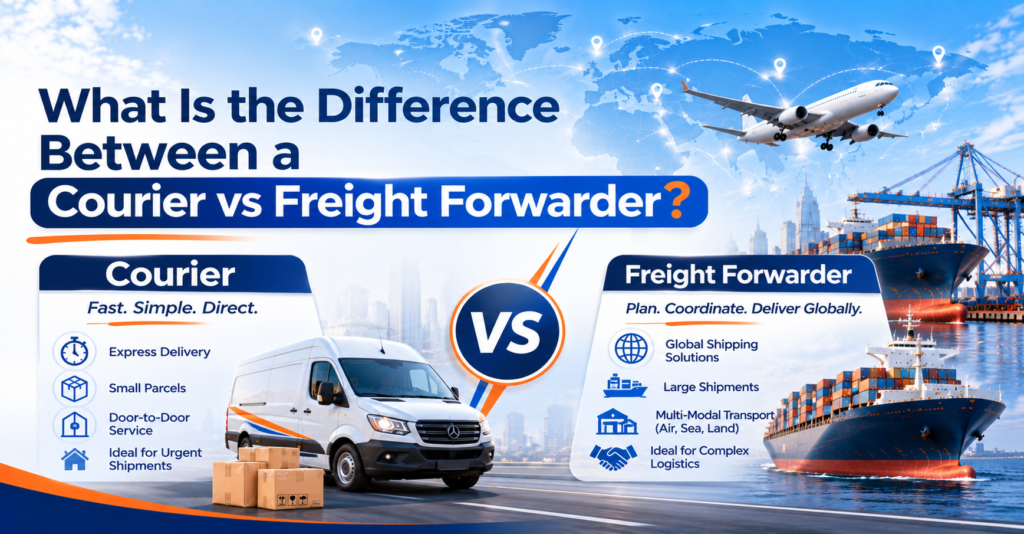
Choosing the wrong shipping partner can increase costs, delay deliveries and create unnecessary complications for your business.
When sending goods locally or internationally, businesses often come across two options: courier companies and freight forwarders. Both help move shipments from one location to another, but they serve different purposes.
Understanding courier vs freight forwarder is important because the right choice depends on what you are shipping, how much you are sending, where it needs to go and how quickly it must arrive.
A courier service is generally suitable for parcels, documents and smaller shipments that need convenient delivery. A freight forwarder, on the other hand, helps businesses organise the transportation of larger or more complex shipments through different transport networks.
What Is a Courier Service?
A courier service is a delivery solution that transports documents, parcels and packages from a sender to a recipient.
Courier companies generally manage parcel collection, transportation, tracking and final delivery. Depending on the provider, they may offer domestic, international, standard and express delivery options.
Businesses commonly use courier shipping services for:
- Important business documents.
- Small product samples.
- E-commerce orders.
- Customer parcels.
- Urgent replacement parts.
- Small packages requiring international delivery.
For example, an online retailer sending a customer’s order from a warehouse to a residential address may use a courier company. The courier collects the package, moves it through its delivery network and delivers it to the customer.
Courier services are particularly useful when convenience, parcel tracking and straightforward delivery arrangements are priorities.
What Is a Freight Forwarder?
A freight forwarder is a company that arranges the transportation of goods from one location to another on behalf of businesses.
Unlike a typical parcel courier, a freight forwarder coordinates different stages of the shipping process. This may include selecting transportation methods, arranging cargo movement, coordinating carriers, preparing shipping documentation and supporting customs clearance.
Freight forwarding services are commonly used for:
- Commercial cargo shipments.
- Bulk goods and raw materials.
- Heavy machinery and equipment.
- Palletised products.
- International imports and exports.
- Large-volume business consignments.
For example, a UK importer purchasing several pallets of products from an overseas manufacturer may work with a freight forwarder. The forwarder can coordinate the movement of goods by air, sea or road, depending on the shipment requirements.
Freight forwarders help businesses manage complex shipping arrangements without having to coordinate every transportation stage independently.
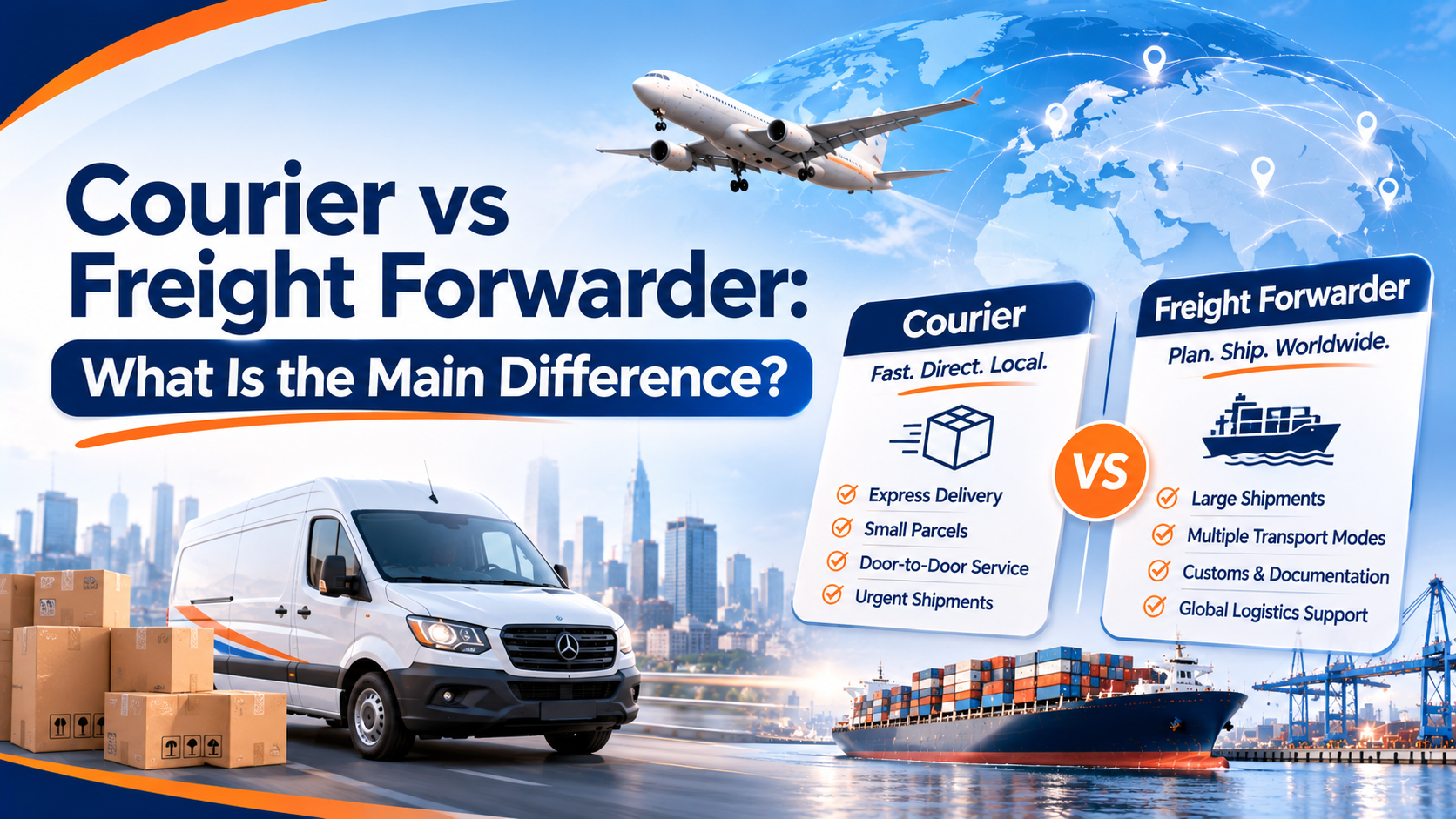
Courier vs Freight Forwarder: What Is the Main Difference?
The main difference between a courier and a freight forwarder is the type and complexity of shipment they handle.
A courier company generally focuses on collecting and delivering individual parcels or documents through an established delivery network. A freight forwarder arranges transportation for cargo shipments and may coordinate several carriers, transport methods and logistics activities.
Here is a quick comparison:
| Comparison Factor | Courier Service | Freight Forwarder |
|---|---|---|
| Main Purpose | Parcel and document delivery | Arranging cargo transportation |
| Shipment Type | Documents, parcels and small packages | Bulk goods, pallets and commercial cargo |
| Shipment Size | Usually smaller shipments | Often larger or heavier shipments |
| Transportation | Uses established courier networks | Coordinates air, sea, road or multimodal transport |
| Delivery Speed | Often offers standard and express options | Depends on transport method and route |
| Pricing | Often based on parcel weight, dimensions and destination | Depends on cargo, route, transport method and services |
| Tracking | Parcel-level tracking is commonly available | Cargo tracking and shipment updates depend on the provider |
| Customs Support | May be included or coordinated for international parcels | Often helps arrange customs-related processes and documentation |
| Best For | Documents, samples and customer orders | Imports, exports and larger commercial shipments |
The exact services and responsibilities vary between providers. Some logistics companies offer both courier and freight forwarding solutions.
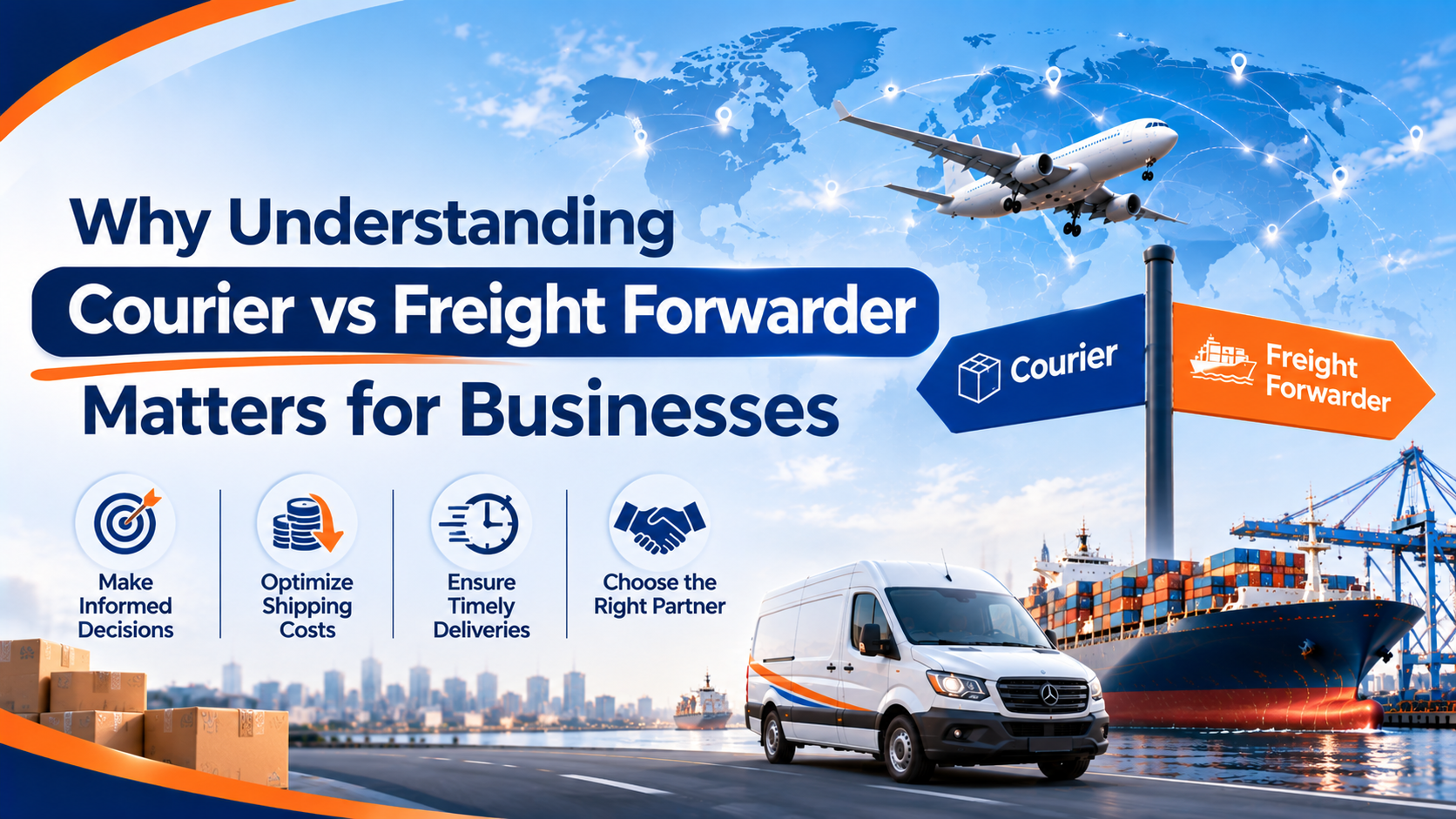
Why Understanding Courier vs Freight Forwarder Matters for Businesses
Selecting the right shipping arrangement can influence delivery schedules, transportation expenses and overall supply chain efficiency.
Businesses that understand the difference can make better decisions based on their actual shipping requirements.
1. Helps Control Shipping Costs
Shipping costs vary depending on parcel size, cargo weight, transportation method, destination and additional services.
Using a freight forwarding arrangement for a small document may be unnecessary, while sending large commercial cargo through individual parcel services may not be economical.
Understanding your options helps you compare suitable services and avoid paying for transportation features you do not need.
For a clearer understanding of the factors involved, businesses can explore this guide to International Shipping Costs.
2. Improves Delivery Planning
Different shipments have different delivery requirements.
An urgent business document may need express courier delivery, whereas a large commercial shipment may be planned around an air or sea freight schedule.
Choosing the right service helps businesses set more realistic delivery expectations.
3. Supports Better Inventory Management
Manufacturers and retailers often depend on the timely arrival of raw materials, stock and finished products.
Freight forwarding can help businesses coordinate larger cargo movements, while courier services can support smaller, urgent deliveries.
Using the appropriate option helps companies manage different types of shipments more effectively.
4. Simplifies International Shipping
Cross-border shipping involves more than moving goods between two locations.
Businesses may need to consider customs procedures, commercial invoices, packing lists, duties, taxes and other destination-specific requirements.
Freight forwarders can help coordinate several parts of the international transportation process, while courier companies may provide integrated international parcel delivery services.
5. Reduces Unnecessary Logistics Complications
When businesses understand what each provider handles, they can choose a suitable shipping partner from the beginning.
This makes it easier to plan collections, prepare documents, compare quotations and coordinate deliveries.
When Should You Choose Courier Shipping Services?
Courier shipping services are generally the better option when you need to send individual parcels, documents or smaller packages.
They are particularly useful when the shipment needs a straightforward collection and delivery arrangement.
Consider using a courier service in the following situations.
Sending Important Business Documents
Contracts, legal paperwork, invoices and other important documents may need to reach a recipient quickly.
A courier service can provide a convenient delivery option, with tracking or delivery confirmation depending on the provider.
Delivering E-Commerce Orders
Online retailers often depend on courier companies to deliver customer orders.
Courier networks help businesses move individual packages from fulfilment centres or warehouses to customers.
Shipping Small Product Samples
Manufacturers and suppliers may need to send samples to potential buyers before confirming larger orders.
A courier service can be suitable when the sample is relatively small and requires direct parcel delivery.
Managing Urgent Small Shipments
If a business needs to send a replacement component, small package or urgent document, an express courier option may be more appropriate than arranging a larger cargo shipment.
When Should You Choose Freight Forwarding Services?
Freight forwarding services are generally more suitable when businesses need to move larger shipments, manage international cargo or coordinate transportation across multiple stages.
Consider working with a freight forwarder in the following situations.
Shipping Large Quantities of Goods
Importers and exporters often transport goods in pallets, containers or other large commercial consignments.
A freight forwarder can help arrange suitable cargo transportation based on shipment size, destination and delivery requirements.
Managing International Imports and Exports
International trade involves several logistics activities, including transportation planning, carrier coordination and customs-related procedures.
A freight forwarder can help businesses organise these activities and understand the requirements involved.
Transporting Heavy Machinery or Equipment
Industrial equipment, manufacturing machinery and oversized cargo may require specialised transportation arrangements.
A freight forwarder can help identify suitable transport options and coordinate the movement of such shipments.
Choosing Between Air, Sea and Road Freight
Businesses may need different transport methods depending on urgency, cargo size and budget.
Freight forwarders can help compare available options and arrange suitable transportation.
For example, companies importing time-sensitive products may consider air freight, while larger shipments with flexible delivery schedules may be suitable for sea freight.
Businesses can learn more through this comparison of Sea Freight vs Air Freight: Which Is Better for UK Importers?.
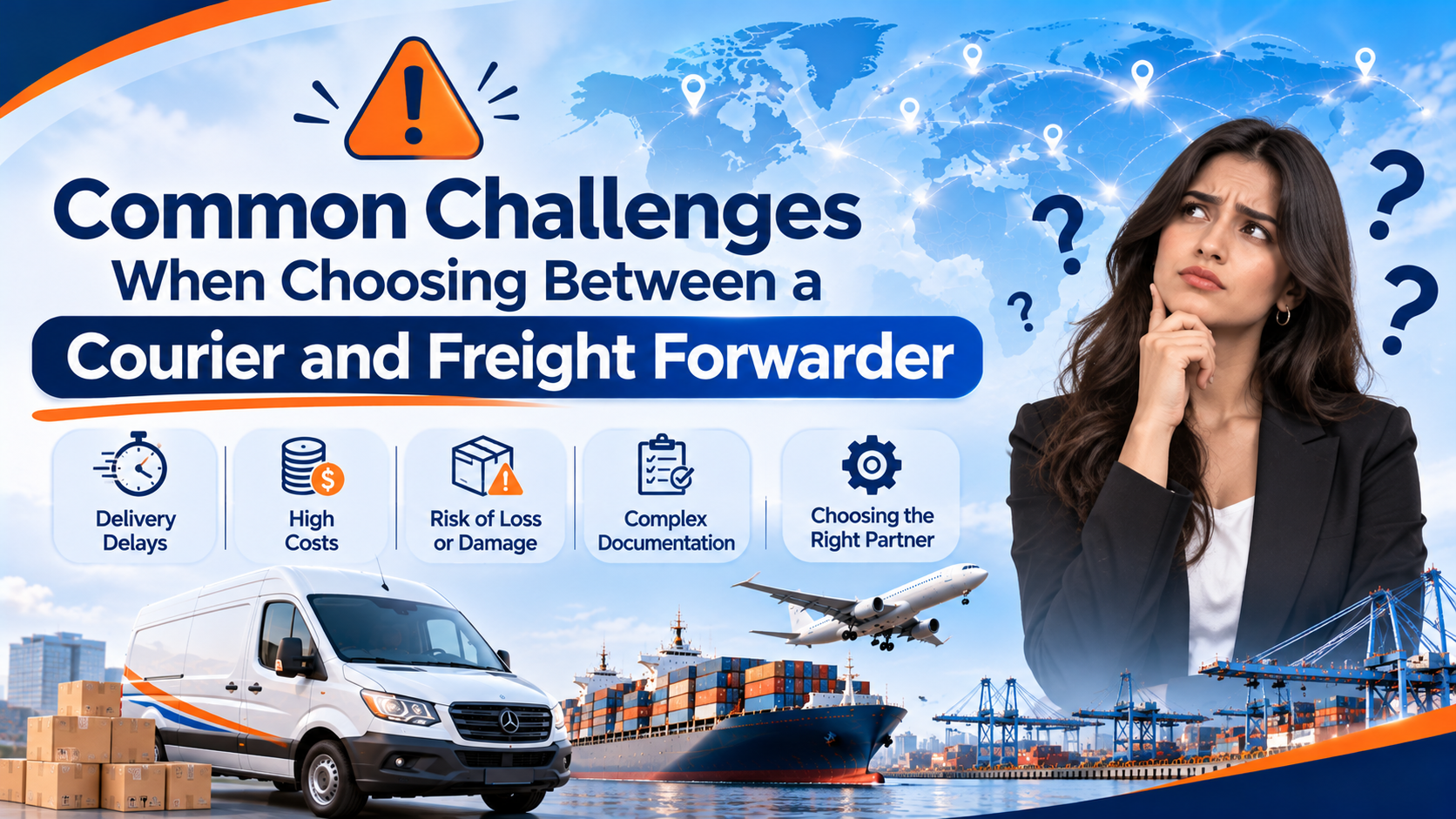
Common Challenges When Choosing Between a Courier and Freight Forwarder
Even after understanding the differences, businesses can face challenges when selecting a shipping solution.
Here are some common issues and ways to manage them.
1. Choosing Based Only on Price
The cheapest quotation may not always provide the most suitable service.
A low-cost option may have longer transit times, limited tracking or additional charges that are not immediately clear.
How to manage it: Compare the complete quotation, including transportation charges, handling fees, additional services and any applicable customs-related costs.
2. Underestimating Shipment Size and Weight
Businesses sometimes select a service without checking how the provider calculates shipment weight and dimensions.
This can result in unexpected charges or unsuitable transportation arrangements.
How to manage it: Measure and weigh the shipment accurately before requesting a quotation. For larger cargo, provide details about the number of packages, pallet dimensions and total weight.
3. Ignoring Delivery Requirements
Not every shipment needs express delivery, and not every shipment can be sent through a standard parcel network.
How to manage it: Identify the required delivery timeframe and compare services that can realistically meet it.
4. Overlooking Customs Documentation
International shipments can experience delays when paperwork is incomplete or inaccurate.
How to manage it: Check the requirements for the goods and destination before dispatch. Businesses should prepare accurate commercial invoices, packing lists and other required documents.
For additional guidance, read this resource on Import and Export Documentation.
5. Not Checking Shipment Handling Requirements
Fragile products, valuable goods and specialised equipment may need additional protection or handling arrangements.
How to manage it: Share accurate shipment details with the service provider and confirm whether suitable handling, packaging and insurance options are available.
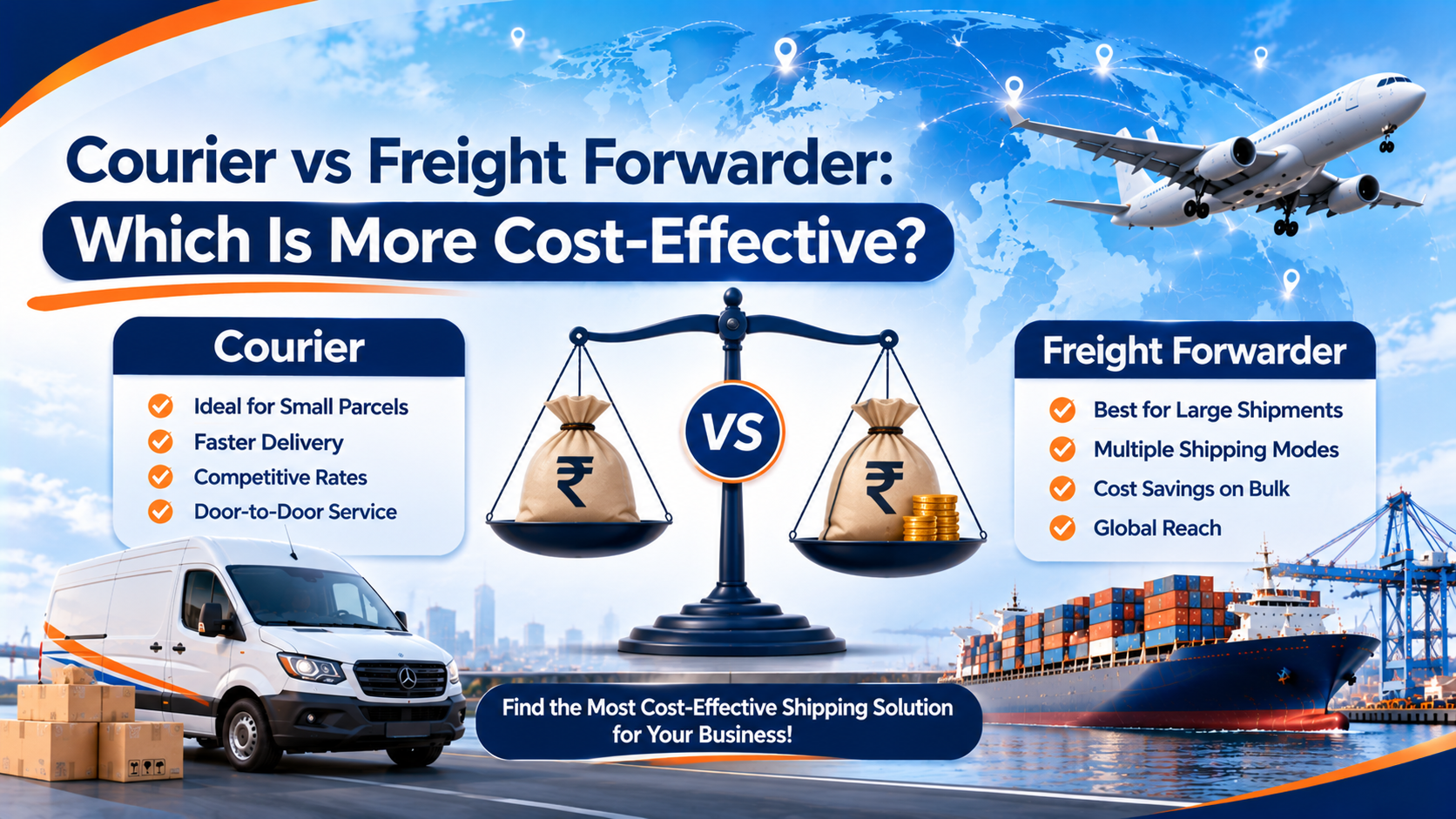
Courier vs Freight Forwarder: Which Is More Cost-Effective?
There is no single answer because the cost depends on the shipment rather than just the type of provider.
Courier services often use pricing based on parcel weight, dimensions, destination and delivery speed. Freight forwarding quotations may consider cargo weight, volume, transport method, route, handling and additional logistics services.
For example:
- Sending a small product sample overseas may be more practical through a courier.
- Shipping several pallets of commercial products may be more suitable for freight forwarding.
- Sending an urgent replacement component may justify express courier charges.
- Transporting a large shipment with a flexible delivery schedule may make sea freight worth considering.
Businesses should compare the total cost of moving the shipment, including any additional charges, rather than looking only at the initial transportation price.

How to Choose the Right Shipping Partner for Your Business
Once you understand the difference between courier and freight forwarding services, the next step is evaluating your business requirements.
Use the following factors to make a more informed decision.
1. Identify Your Shipment Type
Start by identifying what you are sending.
Is it a document, parcel, product sample, pallet or large commercial consignment?
The shipment type will help determine which service is more appropriate.
2. Consider Shipment Weight and Dimensions
Weight and size influence transportation options and shipping costs.
Provide accurate measurements when requesting quotations so that providers can recommend suitable services.
3. Understand Your Delivery Timeline
Determine whether the shipment is urgent or whether a longer transit time is acceptable.
Courier services may suit urgent parcels, while freight forwarding may offer more suitable arrangements for larger cargo shipments.
4. Check Destination and Service Coverage
Confirm that the provider can handle the shipment’s origin and destination.
For international shipments, ask about customs procedures, delivery arrangements and any location-specific restrictions.
5. Compare Total Shipping Costs
Request a detailed quotation and understand what is included.
Check for additional charges related to handling, fuel, customs, storage, insurance or delivery requirements where applicable.
6. Review Tracking and Customer Support
Shipment visibility helps businesses monitor progress and respond to unexpected issues.
Check what tracking information is available and how the provider handles delays, documentation queries and delivery problems.
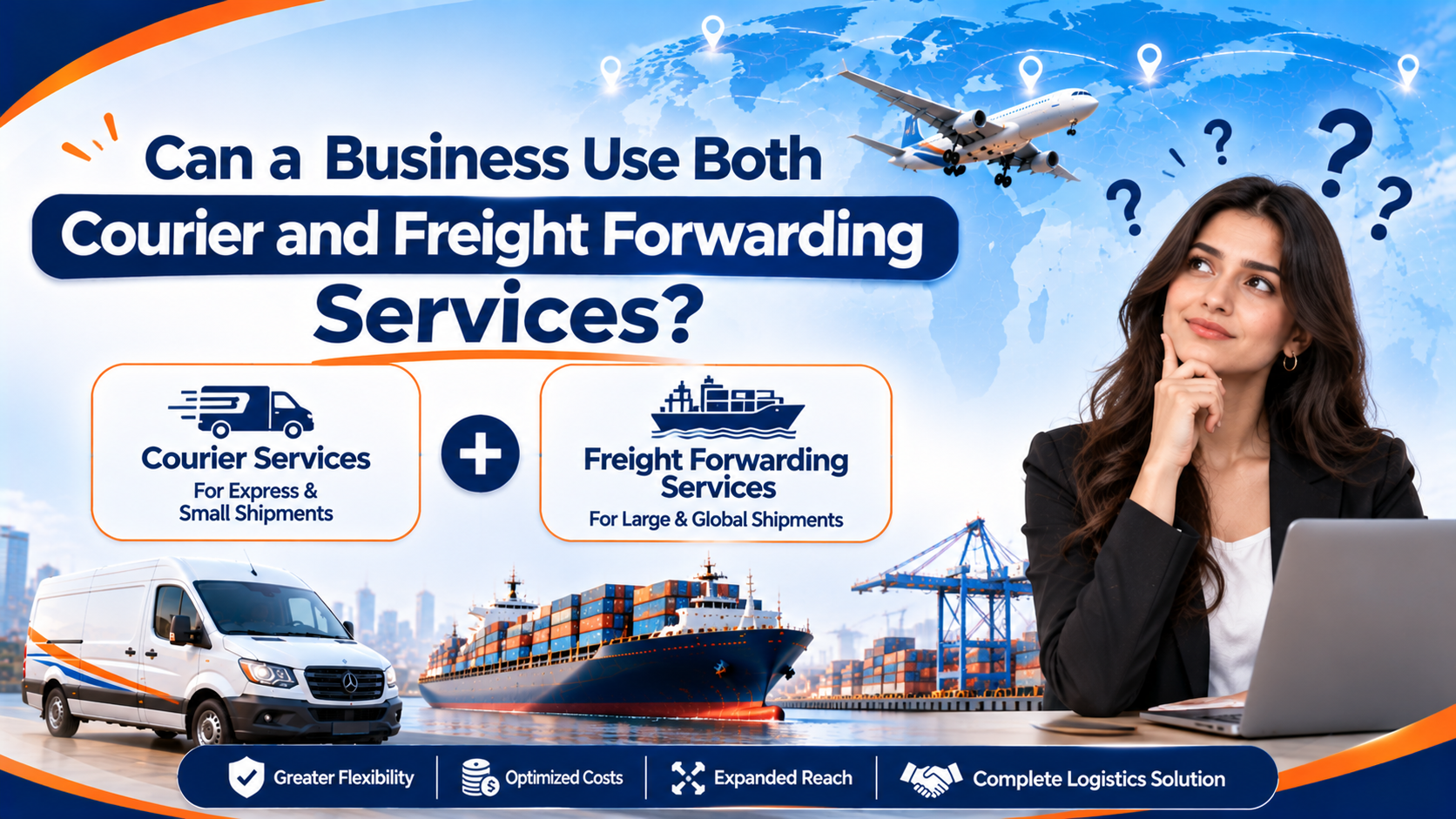
Can a Business Use Both Courier and Freight Forwarding Services?
Yes. Many businesses use both services because they serve different shipping requirements.
For example, an importer may use freight forwarding to transport bulk inventory from an overseas supplier to a warehouse. Once the goods arrive, the business may use courier companies to deliver individual customer orders.
Similarly, a manufacturer may use freight forwarding for regular raw material shipments and courier services for urgent documents or product samples.
Using both options allows businesses to select transportation based on the size, urgency and destination of each shipment.
The key is to avoid treating every delivery requirement in the same way.
Industry Trends Shaping Courier and Freight Forwarding Services
The logistics industry continues to change as businesses expand their supply chains and customers expect more visibility and flexibility.
Several developments are influencing how courier and freight forwarding services operate.
Growing Demand for Shipment Visibility
Businesses increasingly expect clear information about shipment progress.
Digital tracking platforms and automated notifications help companies monitor deliveries and communicate more effectively with customers and suppliers.
Expansion of E-Commerce
The growth of online retail has increased the need for dependable parcel delivery networks.
At the same time, e-commerce businesses importing products in larger quantities may also depend on freight forwarders to move stock between countries.
Greater Focus on Supply Chain Flexibility
Businesses are increasingly comparing different transport methods based on urgency, cost and shipment size.
This encourages companies to use a combination of courier, air freight, sea freight and road transportation where appropriate.
Increased Importance of Customs Compliance
International trade requires businesses to understand customs procedures and documentation requirements.
Accurate shipment information and better coordination can help reduce avoidable administrative delays.
Technology-Driven Logistics Operations
Digital booking systems, shipment tracking, automated documentation and logistics management platforms are making shipping processes more organised.
These tools can help businesses manage multiple shipments and improve communication with logistics providers.
Expert Recommendations: Making the Right Shipping Decision
Before selecting a courier company or freight forwarder, take time to understand what your business actually needs.
Here are some practical recommendations:
- Use courier services for documents, small parcels and individual customer orders.
- Consider freight forwarding for bulk goods, pallets and larger commercial shipments.
- Compare air, sea and road transport based on delivery urgency and cargo requirements.
- Check destination coverage before confirming a shipment.
- Provide accurate weight, dimensions and product descriptions.
- Understand the documentation required for international deliveries.
- Request a complete quotation rather than comparing only the base transportation price.
- Check tracking facilities and customer support.
- Review delivery performance regularly.
- Choose a provider that can support your current shipping needs and future business requirements.
The right shipping partner should help your business move goods efficiently while keeping costs, delivery expectations and operational requirements under control.
Future Outlook: How Courier and Freight Forwarding Services May Evolve
Courier and freight forwarding services will continue to play important roles as businesses trade across wider markets.
Courier companies will remain important for individual parcels, e-commerce orders and time-sensitive deliveries. Freight forwarders will continue to support businesses that need to coordinate larger cargo movements and complex international shipments.
Technology, shipment visibility and more flexible transportation arrangements are likely to influence how businesses select logistics partners.
For companies involved in international trade, understanding the available shipping options will remain essential for managing costs and maintaining reliable supply chains.
Conclusion
Understanding courier vs freight forwarder helps businesses choose the right shipping solution for different transportation needs.
Courier services are generally suitable for documents, parcels, small packages and urgent deliveries. Freight forwarding services are more appropriate for larger cargo shipments, international trade and transportation arrangements involving multiple stages.
The best choice depends on your shipment size, destination, budget, delivery timeline and level of logistics support required.
At NN Freight Ltd, businesses can explore freight and shipping solutions based on their transportation requirements. Whether you are planning international cargo movements or looking for a suitable way to manage your shipping operations, understanding your options is the first step towards a more efficient supply chain.
Frequently Asked Questions
1. What is the difference between a courier and a freight forwarder?
A courier company primarily collects and delivers parcels, documents and smaller packages. A freight forwarder arranges transportation for cargo shipments and may coordinate carriers, customs-related processes and different transport methods for domestic or international movement.
2. Is a freight forwarder the same as a courier company?
No. Both help move shipments, but their services differ. Courier companies generally focus on parcel delivery, while freight forwarders organise cargo transportation and related logistics activities. Some companies may provide both types of services.
3. When should I use a courier service instead of a freight forwarder?
Use a courier service when sending documents, small parcels, product samples or individual customer orders. It is generally more convenient for shipments that require straightforward collection, tracking and final delivery.
4. When should a business use freight forwarding services?
Businesses should consider freight forwarding when transporting bulk goods, pallets, machinery or large commercial shipments. Freight forwarders can help arrange suitable transportation, coordinate carriers and support international shipping requirements.
5. Are freight forwarders cheaper than courier companies?
Not necessarily. Costs depend on shipment weight, dimensions, destination, transportation method and additional services. Courier services may be more practical for small parcels, while freight forwarding may be more suitable for larger cargo.