
Choosing the right shipping method is an important decision for any business importing goods into the United Kingdom. Transportation costs, delivery deadlines, shipment size, and customs requirements can all affect the profitability of an import order. For this reason, understanding Sea Freight vs Air Freight can help UK importers make smarter shipping decisions.
Both shipping methods offer advantages, but the best option depends on your business requirements. Sea freight is generally suitable for large, heavy, and less time-sensitive shipments, while air freight is often preferred for urgent deliveries, high-value products, and time-sensitive inventory.
For example, a UK retailer importing furniture in bulk may benefit from sea freight because of its cargo capacity and cost advantages. However, an electronics supplier needing to replenish popular products quickly may prefer air freight to reduce delivery time.
In this guide, we will explain the differences between sea freight and air freight, compare shipping costs and transit times, and explore how UK importers can choose the most suitable freight solution for their business.
What Is Sea Freight?
Sea freight is a transportation method that moves goods between countries using cargo ships. It is widely used in international trade because ships can carry large quantities of goods, including heavy machinery, furniture, textiles, industrial equipment, and retail inventory.
For UK importers, sea freight shipping is particularly useful when transporting large consignments from international manufacturing and distribution centres.
Businesses can choose between full container load (FCL) and less than container load (LCL) shipping, depending on the volume of their cargo.
How Does Sea Freight Work?
The sea freight process involves several stages, from collecting goods at the supplier’s location to delivering them to the final destination in the UK.
A typical sea freight shipment follows these steps:
- Booking the shipment: The importer provides details about the goods, dimensions, weight, origin, and destination.
- Cargo collection: The goods are collected from the supplier or delivered to the relevant freight facility.
- Export documentation: Required shipping documents are prepared, and export formalities are completed.
- Container loading: The goods are loaded into a dedicated container or consolidated with other shipments.
- Ocean transportation: The cargo travels by sea to the destination port.
- UK customs clearance: Import declarations and applicable customs procedures are completed.
- Final delivery: Once the cargo is released, it is transported to the importer’s warehouse, distribution centre, or business premises.
The actual process depends on the origin country, shipping route, cargo type, and agreed service.
Types of Sea Freight Services for UK Importers
Two common options are FCL and LCL shipping.
Full Container Load (FCL)
FCL shipping means a shipment uses a dedicated container for one customer’s cargo. It is often suitable for businesses importing large quantities of goods or requiring greater control over how their cargo is packed and handled.
FCL can be a practical option for:
- Large furniture shipments
- Industrial machinery and equipment
- Bulk retail inventory
- Manufacturing materials
- Large ecommerce stock orders
Less Than Container Load (LCL)
LCL shipping allows businesses to share container space with shipments belonging to other customers. Instead of paying for an entire container, the importer pays for the space or volume used, subject to the provider’s pricing structure.
LCL can suit:
- Small and medium-sized businesses
- Smaller commercial orders
- Product samples and stock replenishment
- Importers who do not need a full container
However, LCL shipments may require additional consolidation and deconsolidation handling, which can affect the total cost and delivery time.
Advantages of Sea Freight Shipping
Sea freight offers several benefits for UK importers.
1. Lower transportation costs for many large shipments
Sea freight is generally more economical than air freight for large or heavy consignments when comparing the overall transportation cost on a suitable route.
This makes it attractive to wholesalers, retailers, manufacturers, and distributors that regularly import goods in bulk.
2. High cargo capacity
Cargo ships can transport large volumes of commercial products in containers. This makes sea freight suitable for businesses moving substantial quantities of stock in a single shipment.
3. Flexible shipment sizes
With FCL and LCL options, businesses can choose a solution based on their cargo volume and purchasing requirements.
4. Suitable for heavy and bulky goods
Products such as furniture, construction materials, machinery, and industrial equipment can often be transported efficiently by sea.
5. Supports international supply chains
Sea freight connects major international ports and supports the movement of goods between manufacturing centres and UK distribution networks.
Disadvantages of Sea Freight Shipping
Despite its benefits, sea freight has some limitations.
- Longer transit times: Ocean transportation generally takes longer than air freight.
- Potential port delays: Congestion, vessel schedules, weather, and operational disruption can affect arrival times.
- Additional handling: Loading, unloading, and container transfers can add time and cost.
- Planning requirements: Importers need to forecast stock requirements and order goods well before they are needed.
- Additional charges: Port handling, storage, documentation, customs clearance, and inland delivery may increase the final shipping cost.
Sea freight is therefore most effective when businesses can plan ahead and do not require immediate delivery.
What Is Air Freight?
Air freight is a transportation method that moves cargo between countries using aircraft. It is commonly used for urgent shipments, high-value products, lightweight commercial goods, and inventory that needs to reach its destination quickly.
For UK importers, air freight can be particularly useful when a delayed shipment could lead to lost sales, production interruptions, or missed customer deadlines.
Although air freight typically costs more than sea freight, its speed can make it commercially worthwhile in certain situations.
How Does Air Freight Work?
Air freight involves several stages designed to move cargo through airport facilities and international transport networks.
The process generally includes:
- Shipment booking: The importer or supplier provides cargo details and delivery requirements.
- Cargo preparation: Goods are packed, labelled, and prepared according to applicable shipping and safety requirements.
- Collection and transport: The cargo is moved to the departure airport or designated cargo facility.
- Security checks and documentation: The shipment undergoes applicable screening and documentation procedures.
- Air transportation: The goods are transported to the destination airport, sometimes through a connecting airport.
- Import customs clearance: The necessary customs procedures are completed in the UK.
- Final delivery: The cargo is collected and transported to the recipient’s address.
Actual delivery time depends on flight availability, the route, handling arrangements, customs processing, and final-mile transportation.
Businesses with urgent international shipping requirements can explore international freight services for UK deliveries.
Advantages of Air Freight Shipping
Air freight offers several important benefits.
- Faster international transportation
Air freight generally has shorter transit times than sea freight, making it suitable for shipments with strict delivery deadlines.
- Reduced inventory waiting time
Businesses can replenish stock more quickly and may be able to respond to sudden changes in customer demand.
- Suitable for urgent and high-value products
Electronics, specialist components, business-critical spare parts, and other time-sensitive products may benefit from faster transportation.
- Useful for smaller shipments
Air freight can be a practical option for smaller consignments when delivery speed is more important than minimising transportation costs.
- Supports time-sensitive supply chains
Manufacturers and distributors can use air freight to reduce the risk of production interruptions when essential components are urgently required.
Disadvantages of Air Freight Shipping
Air freight also has limitations that businesses should consider.
- Higher transportation costs: Air freight generally costs more per kilogram than sea freight.
- Weight and volume considerations: Charges may be based on actual or volumetric weight, depending on the carrier’s pricing rules.
- Cargo restrictions: Certain goods require specialist handling or may be restricted from air transportation.
- Capacity limitations: Available space and pricing can vary with demand, route, and season.
- Environmental considerations: Air freight generally produces more greenhouse gas emissions per tonne-kilometre than ocean freight.
For businesses importing large quantities of low-margin products, air freight may significantly increase the landed cost of goods.
Sea Freight vs Air Freight: Key Differences
Understanding the main differences between sea freight and air freight can help UK importers select the most suitable transportation method.
Both options can move goods internationally, but they differ in cost structure, transit time, cargo capacity, handling requirements, and environmental impact.
The following table summarises the key differences.
| Comparison Factor | Sea Freight | Air Freight |
|---|---|---|
| Transportation Cost | Generally lower for large shipments | Generally higher per kilogram |
| Transit Time | Usually longer | Usually shorter |
| Cargo Capacity | Suitable for large and bulky consignments | Better suited to smaller or time-sensitive shipments |
| Shipment Options | Full Container Load (FCL) and Less Than Container Load (LCL) | Consolidated and other air cargo services |
| Best Suited For | Bulk goods and planned imports | Urgent shipments and valuable products |
| Inventory Planning | Requires more advance planning | Can support faster stock replenishment |
| Environmental Impact | Generally lower emissions per tonne-kilometre | Generally higher emissions per tonne-kilometre |
| Potential Delays | Port congestion, vessel schedules, and weather | Flight schedules, airport handling, and weather |
| Additional Charges | May include port, container, and handling fees | May include terminal, security, and handling fees |
These are general comparisons. Actual costs, transit times, and service conditions depend on the route, shipment details, service level, and logistics provider.
Shipping Costs: Sea Freight vs Air Freight
Cost is one of the most important factors when comparing sea freight vs air freight.
Sea freight is generally more economical for large consignments because a container ship can carry substantial volumes of cargo. When transportation costs are spread across a large shipment, the cost per unit can be attractive.
Air freight pricing is influenced by the chargeable weight of the shipment. This may be calculated using either actual weight or volumetric weight, depending on which is greater under the applicable pricing rules.
For example, a business importing a large quantity of ceramic products may find sea freight more economical than air freight. However, a small shipment of urgent electronic components may justify the higher cost of air transportation.
Importers should also compare the complete logistics cost rather than the headline freight rate alone.
The total cost may include:
- Origin collection and handling
- Export documentation
- International freight charges
- Insurance, where arranged
- Terminal or port handling
- Customs clearance fees
- Import duty and VAT, where applicable
- Storage or delay-related charges
- Final delivery within the UK
A cheaper transportation quote does not necessarily mean a lower overall landed cost.
Delivery Time and Transit Speed
Delivery time is another major difference between sea freight and air freight.
Air freight is generally faster because aircraft cover international distances in a much shorter time than cargo ships. However, the total door-to-door timeline also includes collection, airport handling, customs clearance, and final delivery.
Sea freight requires more time because shipments must follow vessel schedules and pass through port handling and container operations.
For example, a UK manufacturer waiting for an essential replacement component may choose air freight to reduce the risk of production downtime. A retailer importing seasonal products several months before a sales campaign may choose sea freight to control transportation costs.
Importers should compare the expected door-to-door delivery time rather than looking only at the time spent travelling by aircraft or ship.
Cargo Size, Weight, and Capacity
Sea freight is particularly suitable for heavy, bulky, and high-volume shipments.
FCL shipping provides a dedicated container for one customer’s cargo, while LCL allows smaller consignments to share container space.
Air freight is often better suited to smaller consignments where speed is important. However, it can also transport heavier commercial cargo when aircraft capacity, cargo dimensions, handling requirements, and pricing make it practical.
Businesses should provide accurate dimensions and weight before requesting a quotation. Incorrect measurements can affect chargeable weight, available transport options, and final costs.
Customs Clearance and Documentation
Both sea freight and air freight shipments may require customs declarations, commercial invoices, packing lists, and other documents, depending on the goods and route.
Additional certificates, permits, or specialist documentation may be necessary for certain products.
Customs clearance is not automatically faster simply because the goods arrive by air. Missing paperwork, incorrect commodity codes, valuation issues, or regulatory checks can delay either type of shipment.
UK importers should establish who will prepare the customs declaration, which documents they must provide, and whether customs clearance fees are included in their freight quotation.
For a broader explanation of import-related charges, read this guide to UK customs charges, import duty, VAT, and clearance costs.
Environmental Impact of Sea and Air Freight
Environmental impact is becoming an increasingly important consideration for businesses managing international supply chains.
Sea freight generally produces lower greenhouse gas emissions per tonne-kilometre than air freight, particularly when large volumes of goods are transported efficiently.
Air freight typically has a higher emissions intensity because aircraft consume substantial amounts of fuel to transport cargo at high speeds.
However, the actual environmental impact depends on factors such as the route, aircraft or vessel, fuel use, load factor, cargo weight, and transport stages before and after international shipping.
Businesses seeking to reduce transportation emissions can compare different routes, consolidate shipments, improve cargo utilisation, and avoid unnecessary urgent deliveries where possible.
Sea freight may be the more suitable option when cost and emissions efficiency are priorities and the delivery deadline allows sufficient time.
Sea Freight vs Air Freight: Which Is Cheaper?
For many UK importers, sea freight is the cheaper option for transporting large or heavy shipments. Air freight is usually more expensive per kilogram but can offer business value when speed is essential.
The best choice depends on shipment size, product value, delivery deadlines, route, and the consequences of a delay.
When Is Sea Freight More Cost-Effective?
Sea freight is often a good choice when a business imports substantial quantities of goods and can plan its shipments in advance.
It may be suitable for:
- Furniture and home furnishings
- Clothing and textiles in bulk
- Industrial equipment
- Construction materials
- Large retail inventory orders
- Packaging materials and manufacturing supplies
For example, a wholesaler importing a container of products for distribution across the UK may benefit from sea freight because the transportation cost can be spread across a large quantity of goods.
FCL shipping may be appropriate for a full container, while LCL shipping can provide a more flexible alternative when the cargo does not justify a dedicated container.
However, importers should account for port charges, handling, customs clearance, and inland delivery before deciding that sea freight is the cheapest option.
When Is Air Freight Worth the Extra Cost?
Air freight can be worth the additional expense when fast delivery protects revenue, prevents disruption, or helps a business meet a critical deadline.
Consider air freight when:
- A manufacturer urgently needs replacement parts.
- A retailer has unexpectedly run out of popular stock.
- A customer requires a time-sensitive order.
- High-value products need to reach the destination quickly.
- Delayed delivery could create substantial business losses.
For example, if an electronics distributor cannot fulfil customer orders because a particular component is unavailable, the cost of waiting may exceed the additional cost of air freight.
The decision should consider the commercial consequences of a delay, not just the price of transportation.
Factors That Affect International Shipping Costs
The cost of sea freight vs air freight can vary considerably from one shipment to another.
Key factors include:
Shipment weight and dimensions: Air freight rates can be affected by actual and volumetric weight. Sea freight costs depend on container requirements or, for LCL shipments, the applicable volume and weight rules.
Shipping route: The distance between the origin and destination, available services, and required transport connections affect costs.
Cargo type: Fragile, dangerous, temperature-sensitive, or otherwise specialised goods may require additional handling or documentation.
Seasonal demand: Freight rates and capacity can change during busy shipping periods.
Customs and handling: Clearance, terminal charges, inspections, and other service fees may increase the overall cost.
Final delivery: Transport from the UK port or airport to the final destination can be an important part of the total logistics cost.
To compare options accurately, request quotations based on the same shipment details, origin, destination, service scope, and delivery requirements.
Sea Freight vs Air Freight: Which Is Faster?
Air freight is generally the faster option for international shipping. Sea freight is usually slower because shipments depend on vessel schedules, ocean routes, port operations, and container handling.
However, the actual transit time depends on where the cargo starts, where it is going, and which service is selected.
Typical Sea Freight Transit Times to the UK
Sea freight transit times vary significantly depending on the origin country, port pair, vessel route, and whether the shipment travels directly or through a transshipment port.
For many international routes, ocean transit can take several weeks. The overall door-to-door timeline may be longer once collection, consolidation, export formalities, port handling, UK customs clearance, and final delivery are included.
For example, a UK importer ordering products from an overseas supplier should allow enough time for the cargo to travel, clear customs, and reach its warehouse before the stock is needed.
Businesses should ask their freight forwarder for an estimated transit time based on the actual origin and destination rather than relying on a general industry average.
Typical Air Freight Transit Times to the UK
Air freight is commonly used when cargo needs to reach the UK quickly.
Depending on the route and service, airport-to-airport transportation may take hours or a few days. Door-to-door delivery takes longer because the shipment must also pass through collection, cargo handling, security, customs clearance, and final transport.
Direct flights may offer shorter transit times than routes involving connecting airports. Availability and departure schedules can also influence the delivery estimate.
Importers should confirm whether the quoted transit time covers only the flight or the complete journey from collection to final delivery.
Factors That Can Cause Shipping Delays
Neither sea freight nor air freight guarantees a specific arrival time in every circumstance.
Common causes of delays include:
- Incomplete or incorrect shipping documentation
- Customs inspections or declaration issues
- Port congestion or airport handling delays
- Adverse weather conditions
- Changes to vessel or flight schedules
- Cargo restrictions or security checks
- Delays in collecting or delivering the shipment
- Public holidays and peak-season congestion
Businesses can reduce avoidable delays by preparing documentation early, providing accurate cargo details, booking in advance where possible, and maintaining communication with their logistics provider.
Which Shipping Method Is Best for Different Types of Cargo?
The right freight option depends on the products being shipped, their value, the quantity involved, and how quickly they need to reach the UK.
There is no single transportation method that suits every business.
Best Shipping Method for Heavy and Bulky Goods
Sea freight is often suitable for heavy and bulky goods because containers can accommodate substantial cargo volumes.
Examples include:
- Furniture
- Industrial machinery
- Construction materials
- Large quantities of textiles
- Manufacturing equipment
- Bulk commercial products
For these shipments, sea freight can help businesses manage transportation costs while moving large quantities of goods.
The cargo must still meet the container’s weight, dimension, loading, and handling requirements.
Best Shipping Method for Small and High-Value Products
Air freight can be a practical choice for smaller, high-value products when delivery speed is important.
Examples include:
- Electronic components
- Specialist equipment
- Business-critical spare parts
- High-value commercial samples
- Certain precision instruments
The suitability of air freight depends on the item’s dimensions, value, packaging, and any applicable transport restrictions.
Importers should also assess cargo insurance options and confirm the protection available under the carrier’s or forwarder’s terms.
Best Shipping Method for Perishable and Time-Sensitive Goods
Some perishable products require temperature-controlled transportation and strict handling procedures.
Air freight may be appropriate when products need to reach their destination quickly. However, not every perishable shipment should automatically travel by air.
The correct solution depends on the product’s shelf life, required temperature range, packaging, route, and available cold-chain facilities.
Businesses should confirm that the selected provider and transport service can meet the product’s handling and regulatory requirements before booking.
Best Shipping Method for E-commerce Businesses
E-commerce businesses often need a balance between inventory availability, shipping cost, and customer demand.
Sea freight can be suitable for planned bulk inventory replenishment, especially when products can be ordered well in advance.
Air freight may be helpful for:
- Urgent stock replenishment
- Launching a new product with limited inventory
- Responding to unexpected demand
- Replacing delayed or unavailable stock
For example, an online retailer may import its main inventory by sea and use air freight for selected products that are selling faster than expected.
Sea Freight vs Air Freight: What Should UK Importers Consider?
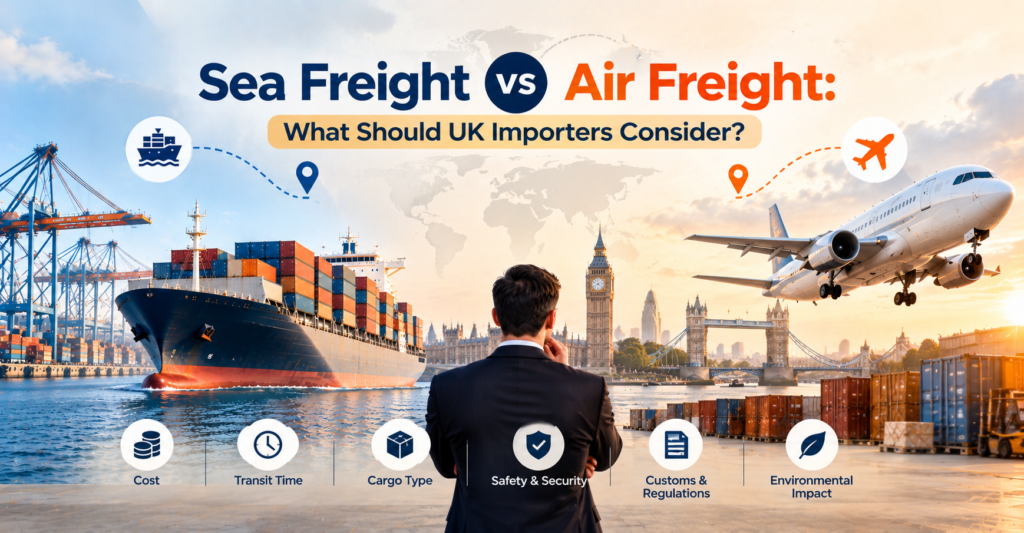
Before selecting a shipping method, UK importers should assess their overall business needs rather than comparing freight prices alone.
The right decision can help control costs, improve inventory planning, and reduce the risk of delivery disruption.
1. Your Shipping Budget
Establish a realistic budget for the complete shipment.
Consider the international freight charge alongside collection, handling, customs clearance, import duty, VAT, insurance, storage, and final delivery where applicable.
Sea freight may provide better value for large consignments, while air freight may be justified for urgent goods that have a high cost of delay.
2. Your Delivery Deadlines
Determine when the goods must arrive and when they need to be available for use or sale.
If your business has sufficient time to plan its inventory, sea freight may be a suitable option.
If missing the delivery deadline could interrupt production or lead to lost sales, air freight may be more appropriate.
Always allow time for customs clearance and final delivery rather than planning around the international transport time alone.
3. Your Shipment Size and Weight
Shipment dimensions and weight influence the available transport options and total cost.
Large consignments may be suitable for FCL sea freight, while smaller shipments may be better suited to LCL or air freight, depending on urgency and pricing.
Provide accurate measurements and packing details when requesting a quotation.
4. Customs Duties, Taxes, and Import Regulations
Importers must understand the customs and regulatory requirements applicable to their goods.
Depending on the shipment, requirements may include:
- A commercial invoice
- A packing list
- Transport documents
- An appropriate commodity code
- Customs declarations
- Certificates, licences, or permits for certain products
- Information about the origin and customs value of the goods
Import duty and VAT depend on the applicable rules, the type of goods, and other relevant factors. They should not be assumed to be included in the international freight price.
A freight forwarder can help coordinate relevant documentation and customs procedures according to the agreed service, but importers should understand their own compliance responsibilities.
5. Your Inventory and Supply Chain Requirements
Consider how frequently your business needs stock and how much inventory it can afford to hold.
Businesses with predictable demand may be able to plan bulk sea freight shipments in advance.
Companies with fluctuating demand may benefit from a more flexible approach that combines planned sea freight with occasional air freight for urgent products.
The goal is to find a balance between transportation cost, stock availability, storage expenses, and customer expectations.
6. Your Cargo's Handling Requirements
Certain products require special packaging, handling, temperature control, or regulatory checks.
Before booking, confirm that the selected shipping method can accommodate your cargo and that all necessary documentation and packaging requirements are understood.
This is particularly important for fragile, temperature-sensitive, restricted, or regulated goods.
How to Choose the Right Freight Forwarder in the UK
Choosing the right freight forwarder is just as important as choosing between sea freight and air freight.
A reliable logistics partner can help coordinate transportation, documentation, customs procedures, and final delivery, giving your business greater visibility over its international shipments.
Here are several factors to consider.
Compare Freight Rates and Transit Times
Request quotations from providers that can handle your route and cargo requirements.
Compare the total price, expected transit time, included services, exclusions, and any potential additional charges.
A low initial quote may not represent the best value if essential handling or delivery services are excluded.
Check Customs Clearance and Documentation Support
Ask how the provider handles import and export documentation and whether customs clearance coordination is available.
Clarify which documents your business must supply and which responsibilities are covered by the agreed service.
Good preparation can help reduce avoidable administrative delays.
Look for End-to-End Shipping Solutions
Managing collection, international transport, customs clearance, and final delivery through separate providers can create additional coordination work.
Depending on your requirements, using a freight forwarder that can coordinate several stages of the shipment may simplify the process.
Look for clear communication, realistic delivery estimates, shipment updates, and transparent pricing.
Consider Experience With Your Shipment Type
Different products and shipping routes can involve different operational requirements.
Ask whether the provider can accommodate your shipment’s size, handling needs, destination, and expected delivery schedule.
For a more detailed checklist, read our guide on how to choose the right freight forwarder in the UK.
Why Choose NN Freight Ltd for Your Shipping Needs?
When comparing sea freight vs air freight, UK importers need more than a transportation booking. They need a shipping solution that fits their cargo, budget, delivery schedule, and operational requirements.
NN Freight Ltd provides freight and logistics services for businesses requiring international transportation and UK distribution support.
Depending on your shipment, available services include:
Sea freight solutions: Explore FCL and LCL shipping options, cargo consolidation, container coordination, and support for international shipments through NN Freight Ltd’s sea freight services.
International freight coordination: Businesses importing goods into the UK can review freight shipping services to the UK for information about transportation, customs support, warehousing, and delivery arrangements.
Customs clearance support: Customs documentation and clearance coordination can help businesses prepare for the relevant import procedures.
UK distribution and logistics: Depending on the shipment and agreed service, businesses can explore options for transporting goods onwards to their warehouse or final delivery address.
The most suitable service depends on the origin, destination, cargo details, and delivery requirements. Before booking, request a quotation that clearly identifies the services included and any additional charges that may apply.
Conclusion
Choosing between sea freight and air freight depends on your business priorities, shipment size, budget, and delivery deadline.
Sea freight is generally the better choice for large, heavy, or less time-sensitive shipments where controlling transportation costs is important. FCL and LCL options also allow businesses to select a shipping arrangement that suits their cargo volume.
Air freight is generally better for urgent deliveries, high-value products, and time-sensitive inventory where a shorter transit time can provide meaningful business benefits.
When comparing Sea Freight vs Air Freight, UK importers should consider the complete landed cost, expected door-to-door delivery time, customs requirements, cargo handling needs, and potential consequences of delays.
For some businesses, combining both shipping methods can provide a practical balance between cost efficiency and flexibility.
If you are planning an international shipment, NN Freight Ltd can help you explore suitable freight and logistics options based on your requirements. Visit the NN Freight to learn more about its services and request a tailored quotation.
FAQs
Q1. What is the difference between sea freight and air freight?
The main difference between sea freight and air freight is the transportation method, delivery time, and cost. Sea freight transports goods by cargo ships and is generally more economical for large or heavy shipments. Air freight transports goods by aircraft and is usually faster, making it suitable for urgent deliveries and time-sensitive products. The best option depends on your shipment size, budget, and delivery requirements.
Q2. Is sea freight cheaper than air freight?
Yes, sea freight is generally cheaper than air freight for large, heavy, or high-volume shipments. It allows businesses to transport substantial quantities of goods at a lower transportation cost per unit. Air freight usually costs more because of its speed and pricing based on chargeable weight. However, UK importers should compare the complete shipping cost, including handling, customs clearance, and final delivery, before choosing a service.
Q3. Is air freight faster than sea freight?
Yes, air freight is generally faster than sea freight because aircraft transport goods over international distances in a shorter time. Depending on the route and service, air transportation may take hours or a few days, while sea freight can take several weeks. Actual door-to-door delivery times depend on cargo collection, handling, customs clearance, and final transportation.
Q4. How long does sea freight take to reach the UK?
Sea freight transit times depend on the origin country, destination port, shipping route, and vessel schedule. International ocean transportation can take several weeks, and the complete door-to-door process may take longer because of collection, port handling, customs clearance, and final delivery. UK importers should request a route-specific transit estimate and allow additional time for potential delays.
Q5. How much does air freight cost to the UK?
Air freight costs vary according to the shipment’s origin, destination, actual weight, volumetric weight, cargo type, and required service. Additional charges may apply for collection, handling, security, customs clearance, and final delivery. To obtain an accurate quotation, UK importers should provide the shipment dimensions, weight, product description, collection address, and delivery destination.